Uses, knowledge, and extinction risk
Happy Halloween

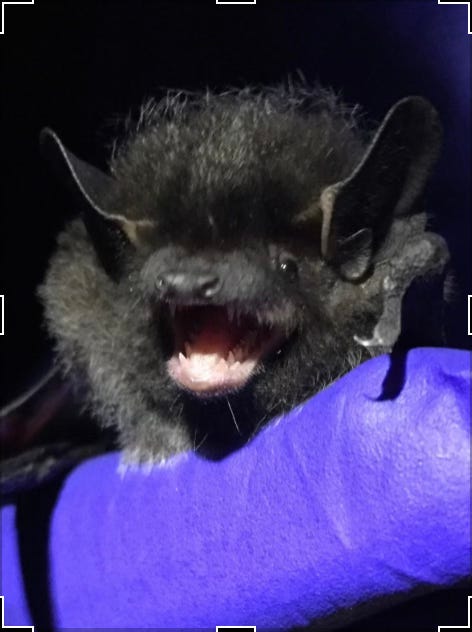
Photo Credit: Amanda Bevan Zientek. Amanda’s a bat expert. Please read one of her essays here.
Those who find bats disturbing will not be surprised to know Bat Week coincides with Halloween. If you are among them, perhaps when you reach the end of this piece, you’ll think an international bat day could be designated on Cinco de Mayo.
The oldest bat skeletons on hand date back to the Eocene, over fifty million years ago, and bats were likely established in many of their current habitats, including in the arctic circle, when, in Ricardo Rocha and his team’s words, early hominids took their first steps. They also suggest our ancetsors lived alongside bats during their cave-dwelling millenia. Late Pleistocene terracotta paintings of bats were left by hunter-gatherers along the Amazon, and although bats were associated with witchcraft and death in many cultures, they were considered good omens and taken as spiritual totems in other places, especially in the Asia-Pacific region.
Agave tequiliana, or blue agave, lives up to its name: agave, taken from Latin, illustrious or noble, and of course the source of tequila. The lance-like leaves of the basal rosette can grow to over seven feet, and the flowering stalk, produced only once before the plant dies, can reach 16 feet. Currently agave is considered a succulent adaptation within the Asparagaceae family. Some are surprised to learn that many families, including the rose, include such adaptations to arid conditions.
Many species seek food and shelter in agaves, and the shallow roots help stabilize desert soils. Long in human use, agaves are important sources of food, fiber for clothing, baskets, and rope, soap in Mexico, and of course tequila and mezcal, and lesser known bacanora and raicilla. Tequila exports from Jalisco, where 90% of production takes place, rose from $1.6 billion in 2016, to $2.3 billion in 2020, and an estimated 40,000 families rely on agave production for their livelihoods.
Agave tequiliana, the source of tequila, is not common in the wild, and largely cultivated, while mezcal is sourced from perhaps 56 agave taxa common in the wild.
The Mexican long-nosed bat, eptonycteris nivalis, endangered in both Mexico and America, is the most important pollinator of agave species, and the relationship of the two species is believed to be an example of coevolution. (Two other bat species share in the pollination work.)
For example, EP Gomez-Ruiz and TE Lacher suggest that the hanging night-blooming flowers of the agave are adaptations to bat pollination. They have also found that areas with larger populations of agave species tend to be distributed along mountain chains, and that the bats travel along those corridors, following the bloom times of the agaves, as they migrate from Central Mexico to the Southern United States each spring. Agaves are their only nectar source in their northern range. Because of their size, bats are well equipped to carry pollen among tall, interspersed agaves,
Many females make this journey of more than 700 miles while pregnant. They give birth to their single pup while upside down—they have to catch it quickly—in the American southwest, where they nurse the pup, eventually sharing nectar with it, and then flying back to Mexico together when the pup is strong enough to make the trip.
Agaves are in severe decline One study, Uses, Knowledge and Extinction Risk Faced by Agave Species in Mexico, the source of our title, found 42 of the 168 identified species threatened or severely endangered.
Long-nosed bat populations are down by 50% over the last two decades, the Mexican long-tongued bat is near threatened, while the lesser long-nosed bat has made a spectacular recovery, with the population up from 1,000 in 1988 to 200,000 today.
Lack of information is always part of the problem, as is climate change, and a bi-national “landscape scale” replanting and education effort is underway. Much of Mexican land is in public ownership, and scientists work closely with residents on these projects.
Within the tequila and mezcal industries, Dr. Rodrigo Medellin, the Bat Man of Mexico, has led an effort to reinstate traditional practices in the agave fields. Many traditional growers have maintained the bat/agave relationship in their fields, but over the last century, the “industrial” practice has been to cut the expensive inflorescence before it flowers to preserve sugars in the leaves of the rosette for a heavier crop. That forces the use of clonal propagation that suppresses biodiversity, and deprives bats of a critical nectar source. Sharing the same genetic information, cloned agaves throughout the region are more susceptible to plague, disease, and pests.
The Bat Friendly Project, run through the Institute of Ecology of the National Autonomous University of Mexico,
requires agave-growing members to allow five percent of their crop to flower each year, reestablishing biodiversity within the species, and supporting the bats that feed on the nectar. Ana Ibarra, regional director at Bat Conservation International, is already seeing more bat pups. These are not jumps, but they are “steady… When you’ve seen steady decline, just keeping the numbers stable is a huge win.” Conservation science works.
Our Fish and Wildlife Service identifies bats as among the most important misunderstood animal in our ecosystems. Bats have long been known to eat destructive pests—estimates now run at savings more than $3 billion in agricultural damage each year—and their critical roles in pollination and seed dispersal are becoming better understood. The Fish and Wildlife Service reports bats are responsible for up to 95% of seed dispersal that lead to early growth in cleared rainforests.
As Barry Lopez once wrote about wolves, people fear bats more than they need to, and respect them less than they should. Bats are indeed rabies vectors, but the published statistics can be misleading. For example, here the Santa Cruz County Mosquito and Vector Control Board reports that 78% of 239 cases of rabies in a recent year were discovered in bats, but does not mention that the infection rate in wild bats is less than 1%. Bats submitted for testing generally are more likely to be rapid because they have exhibited behavior suggesting rabies, including taking flight in daylight, difficulty moving properly, and willingly approaching people and pets.
As the pandemic has drawn attention to zoonotic transmissions, it’s worth noting that recent research suggests the spillovers of viruses are facilitated in degraded habitats. For example, it’s believed that transfers of ebolaviruses in West Africa are enabled by agriculturally degraded forest margins that bring bats, the suspected reservoirs, into contact with local residents, making such diseases a joint effort.
Returning to the Halloween theme, and trigger warning! Bats have complicated and poorly understood social structures and communications. As the science of animal communication continues to move forward, vampire bats are now believed to be altruistic. If these sanguivores encounter a weak or hungry looking colony mate upon returning from an evening of doing their thing, they regurgitate blood to feed him or her, now believed to be a way of building reciprocal relationships.
The Fish and Wildlife Service suggests that if you encounter a bat where you don’t want it to be, you should relocate it humanely, and if you call a removal service, ask if they use humane methods.
And if you are inclined to drink tequila or mezcal, or bacanora and raicilla if you can find them, please look for this logo, or ask for bat-friendly brands. Partial list here.